
The Hagia Sophia enjoyed the status as the largest cathedral in the world for almost a thousand years after it was built, till 1850.The Hagia Sophia or Ayasofya as it is known in Turkish was actually a patriarchal Basilica that has been considered to be an embodiment of Byzantine architecture. Its interiors were richly decorated with artistic mosaics depicting various religious scenes and were supported by massive marble pillars.The Hagia Sophia has a diameter of 31-33 m and a height of 54m and is covered with a large dome.
Unfortunately nothing remains of the original Hagia Sophia, which was built on this site in the 4th century by Constantine the Great. He was the first Christian emperor and the founder of the city Constantinople, which he called "the New Rome".Following the destruction of Constantine's church, a second was built by his son Constantius and the Emperor Theodosius the Great. This second church was burned down during the Nika riots of 532, though fragments of it have been excavated and can be seen today. Hagia Sophia was rebuilt in her present form between 532 and 537 under the personal supervision of Emperor Justinian 1.The architects of the church were Isidore of Miletus and Anthemius of Tralles, who were professors of geometry at the University of Constantinople.The structure was severely damaged several times by earthquakes.
 |
| Imperial Gate |
For over 900 years the Hagia Sophia was the seat of the Orthodox Patriarch of Constantinople and a principal setting for church councils and imperial ceremonies.In 1204 the Cathedral was ruthlessly attacked and plundered by the Crusaders, who also ousted the Patriarch of Constantinople and replaced him with a Latin Bishop.This event cemented the division of the Greek Orthodox and Roman Catholic Churches.In 1453, when Sultan Mehmet the Conqueror entered triumphantly into the city of Constantinople, he was amazed at the beauty of the Hagia Sophia and immediately converted it into his imperial mosque. Hagia Sophia served as the principal mosque of Istanbul for almost 500 years.
No major structural changes were made at first, the addition of a mihrab, minbar and a wooden minaret made a mosque out of a church.The church's mosaics were covered in plaster due to the Islamic prohibition of figurative imagery.Sultan Mehmed II built a madrasa near the mosque and organized a waqf for its expenses.The most famous restoration of the Hagia Sophia was completed between 1847 and 1849 by Abdulmecid II, who invited Swiss architects Gaspare and Guiseppe Fossati to renovate the mosque.They had uncovered the figural mosaics for cleaning and recording.They also added the calligraphic roundels that remain today.
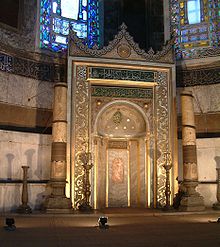 |
| The mihrab |
One of the remarkable features that the Hagia Sophia boasted of was the Upper Imperial Gallery.The central part of the upper gallery was reserved for the Empress and the other women of her court, who could sit there and view the proceedings down below in a discreet manner.So it was also known as the Loge of the Empress.
 |
| Interior of Hagia Sophia |
One of the most striking features of the Hagia Sophia during the Byzantine rule was its magnificent interiors.The entry to the nave was by itself quite a majestic affair, where one was exposed to several descriptive mosaics above the ornamental doors.All the walls and the ceilings of the nave are covered with inlayed marble and mosaics and altogether it brought about a bright and colorful experience.Initially, the upper part of the building was minimally decorated in gold with a huge cross in a medallion at the summit of the dome.When the Hagia Sophia was used as a place of worship both for Christians and then for Muslims, the focus of the building was the east end, directly across from the entrance.This is because Christian churches are traditionally oriented towards the east, and Muslims always pray facing Mecca, which is southeast of Istanbul.
 |
| The Deesis mosaic with Christ as ruler |
In 1934, under Turkish President Atatürk, Hagia Sophia was secularized and turned into the Ayasofya Museum.Some of the calligraphic panels were moved to other mosques, but eight roundels were left and can still be seen today.Restorers have attempted to maintain a balance between both Christian and Islamic cultures.


No comments:
Post a Comment