Thursday, March 1, 2012

REALLY SMALL


Thanks: crazy people with crazy things.

Sunday, February 19, 2012

HAGIA SOPHIA


The Hagia Sophia enjoyed the status as the largest cathedral in the world for almost a thousand years after it was built, till 1850.The Hagia Sophia or Ayasofya as it is known in Turkish was actually a patriarchal Basilica that has been considered to be an embodiment of Byzantine architecture. Its interiors were richly decorated with artistic mosaics depicting various religious scenes and were supported by massive marble pillars.The Hagia Sophia has a diameter of 31-33 m and a height of 54m and is covered with a large dome.

Unfortunately nothing remains of the original Hagia Sophia, which was built on this site in the 4th century by Constantine the Great. He was the first Christian emperor and the founder of the city Constantinople, which he called "the New Rome".Following the destruction of Constantine's church, a second was built by his son Constantius and the Emperor Theodosius the Great. This second church was burned down during the Nika riots of 532, though fragments of it have been excavated and can be seen today. Hagia Sophia was rebuilt in her present form between 532 and 537 under the personal supervision of Emperor Justinian 1.The architects of the church were Isidore of Miletus and Anthemius of Tralles, who were professors of geometry at the University of Constantinople.The structure was severely damaged several times by earthquakes.

Imperial Gate

For over 900 years the Hagia Sophia was the seat of the Orthodox Patriarch of Constantinople and a principal setting for church councils and imperial ceremonies.In 1204 the Cathedral was ruthlessly attacked and plundered by the Crusaders, who also ousted the Patriarch of Constantinople and replaced him with a Latin Bishop.This event cemented the division of the Greek Orthodox and Roman Catholic Churches.In 1453, when Sultan Mehmet the Conqueror entered triumphantly into the city of Constantinople, he was amazed at the beauty of the Hagia Sophia and immediately converted it into his imperial mosque. Hagia Sophia served as the principal mosque of Istanbul for almost 500 years.

No major structural changes were made at first, the addition of a mihrab, minbar and a wooden minaret made a mosque out of a church.The church's mosaics were covered in plaster due to the Islamic prohibition of figurative imagery.Sultan Mehmed II built a madrasa near the mosque and organized a waqf for its expenses.The most famous restoration of the Hagia Sophia was completed between 1847 and 1849 by Abdulmecid II, who invited Swiss architects Gaspare and Guiseppe Fossati to renovate the mosque.They had uncovered the figural mosaics for cleaning and recording.They also added the calligraphic roundels that remain today.
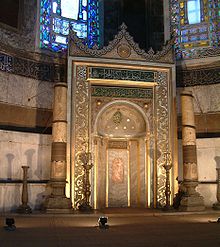
The mihrab

One of the remarkable features that the Hagia Sophia boasted of was the Upper Imperial Gallery.The central part of the upper gallery was reserved for the Empress and the other women of her court, who could sit there and view the proceedings down below in a discreet manner.So it was also known as the Loge of the Empress.

Interior of Hagia Sophia
One of the most striking features of the Hagia Sophia during the Byzantine rule was its magnificent interiors.The entry to the nave was by itself quite a majestic affair, where one was exposed to several descriptive mosaics above the ornamental doors.All the walls and the ceilings of the nave are covered with inlayed marble and mosaics and altogether it brought about a bright and colorful experience.Initially, the upper part of the building was minimally decorated in gold with a huge cross in a medallion at the summit of the dome.When the Hagia Sophia was used as a place of worship both for Christians and then for Muslims, the focus of the building was the east end, directly across from the entrance.This is because Christian churches are traditionally oriented towards the east, and Muslims always pray facing Mecca, which is southeast of Istanbul.
The Deesis mosaic with Christ as ruler

In 1934, under Turkish President Atatürk, Hagia Sophia was secularized and turned into the Ayasofya Museum.Some of the calligraphic panels were moved to other mosques, but eight roundels were left and can still be seen today.Restorers have attempted to maintain a balance between both Christian and Islamic cultures.


Thursday, February 9, 2012

GREAT PYRAMID OF GIZA


The word pyramid is derived from the Greek words PYRAMIS (means 'obscure') and PYRAMIDOS(means 'Fire in the Middle').The Great Pyramid of Giza is one of the seven wonders of the ancient world and the only one still remaining to this day. It is believed that this pyramid was built as a tomb for Fourth dynasty Egyptian King Khufu (Cheops in Greek),so it is also known as the Great Pyramid of Khufu or the Great Pyramid of Cheops.It was built around 2560 BC, taking about 20 years to complete.

The Great Pyramid of Giza stands on the northern edge of the Giza plateau, located about 10 miles west to Cairo.It is composed of over two and half million blocks of limestone,which weigh from 2 to 70 tons each.The estimated total weight of the structure is 6.5 million tons.Its base covers over 13 acres and its volume is around 90,000,000 cubic feet.It is 454 feet high which is equivalent to a modern 48 storey building.It was the tallest man made structure in the world for over 3,800 years.There are currently 203 steps to its summit.Each of the four triangular sides slope upward from the base at an angle of 51 degrees 51 minutes and each side has an area of 5 and 1/2 acres.

casing stone
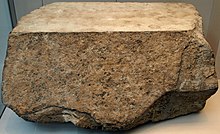
Actually the Great Pyramid was covered by casing stones that formed a smooth surface, but majority of it was removed about 600 years ago to build cities and mosques and what is seen today is the underlying core structure.The cement that was used is extremely fine and strong.There are three known chambers inside the Great Pyramid.The lowest chamber is cut into the bedrock upon which the pyramid was built and was unfinished.The Queen's Chamber and King's Chamber are higher up within the pyramid structure.Many of the casing stones and inner chamber blocks of the Great Pyramid were fit together with extremely high precision.

The entrance of the Great Pyramid


The original entrance to the Great Pyramid is 17m vertically above ground level and 7.29m east of the center line of the pyramid.From this entrance, there is a Descending passage 0.96m high and 1.04m wide which goes down at an angle of 26 degree 31'23" through the masonry of the pyramid and then into the bedrock beneath it.After 105.23m, the passage becomes level and continues for an additional 8.84m to the lower chamber, which appears not to have been finished.At 28.2m from the entrance is a square hole in the roof of the Descending passage.Originally concealed with a slab of stone, this is the beginning of the Ascending Passage.This Passage is 39.3m long, as wide and high as the Descending passage and slopes up at almost precisely the same angle.Its lower end is closed by three huge blocks of granite, each about 1.5m long.At the start of the Grand Gallery on the right-hand side there is a hole cut in the wall. This is the start of a vertical shaft which follows an irregular path through the masonry of the pyramid to join the Descending Passage.Also at the start of the Grand Gallery there is a horizontal passage leading to the Queen's Chamber.The Great Pyramid is the only one to have a magnificent grand gallery in its ascending system, which makes its so unique.The purpose of this gallery still remains a mystery.

The Grand Gallery
Shafts and Passages of the Great Pyramid


The Great Pyramid demonstrates the remarkable character of its placement on the face of the Earth.The Pyramid lies in the center of gravity of the continents.It also lies in the exact center of all the land area of the world, the earth's land mass into approximately equal quarters.One very unusual feature of the Great Pyramid is a concavity of the core that makes the monument an eight-sided figure, rather than four-sided like every other Egyptian pyramid..Though it is apparently more easily observed from the air, the concavity is measurable and is visible from the ground under favorable lighting conditions.The purpose for the concavity of the Great pyramids remains a mystery and no satisfactory explanation for this feature has been offered, even though some scientists proposed that that the slightly concave walls were intended to increase the stability of the Pyramid's mantle.

Diagram of the concavity


The dimensions of the Great Pyramid of Giza reveal incredible mathematical insights!The Great Pyramid solves one of humanity's most difficult mathematical challenges-the squaring of the circle.When the radius of a circle equals the height of the pyramid, then the circumference of that circle equals the perimeter of the pyramid's base.Indeed, twice the height of the Great Pyramid, divided into the distance around its base, equals nearly perfect pi.Mankind has only recently been able to calculate pi to this level of mathematical accuracy.The Great Pyramid also contains the golden ratio.

The length of each side of the Great Pyramid's base is 365.2422 Royal Egyptian cubits (pyramid cubits).Amazingly, our astronomical year has a mean length of 365.2422454 solar days.Also, the perimeter of the base of the Great Pyramid is 36524.22 "pyramid inches", the length of 100 years expressed in days.Calculations of such accuracy weren't known in mainstream mathematics until the 20th century. 

It appears that the Great Pyramid was never finished since the top is flat and not pointed, as it should be.Most pyramids were crowned with a top-stone that completed their structure.This pyramid does not currently have one and it appears that it never did.Also it appears that between the different courses of stones there is a thin cement which is absent on the upper surface of the highest course.Why the pyramid was never finished remains a mystery.


Saturday, February 4, 2012

THE GREAT WALL OF CHINA


The Great Wall of China, whose building started more than 2000 years ago, represents a main part of Chinese history, which has a profound influence on china today.It is the world's longest and largest human-made structure, stretching over approximately 8,851.8km, across the mountains of northern China, winding north and northwest of Beijing. The Great Wall is a series of stone and earthen fortifications in, built, rebuilt and maintained between the 5th century BC and the16th century AD to protect the northern borders of the Chinese Empire during the rule of successive dynasties.In Chinese the wall is called "Wan -Li Qang-Qeng", which means 10,000-Li Long Wall (10,000 Li = about 5,000km).

The purpose of the Great Wall was to protect China from outside aggression, but also to preserve its culture from the customs of foreigners. The Wall was originally built in the Spring and Autumn, and Warring States Periods as a defensive fortification by the three states: Yan, Zhao and Qin. It went through constant extensions and repairs in later dynasties.It began as independent walls for different states when it was first built and became the "Great Wall" when the Qin Dynasty Emperor Qin Shihuang succeeded in his effort to have the walls joined together to fend off the invasions from the Huns in the north.The Great Wall we see today was mostly built during the Ming Dynasty (1368-1644).It starts from Hushan Great Wall in the east to Jiayuguan Pass in the west traversing Liaoning, Hebei, Beijing, Tianjin, Shanxi, Inner Mongolia, Ningxia, Shaanxi, Gansu and Qinghai.


The mystery of the construction of the wall is amazing. The construction ,which drew heavily on the local resources for construction materials, was carried out in-line with the local  conditions under the management of contract and responsibility system. A great army of manpower, composed of soldiers, prisoners and local people, built the wall.The wall was originally built of stone, wood,grass and earth. In the Ming Dynasty, bricks were produced in kilns set up along the wall.The bricks were transported by men carrying them on their backs, donkeys,mules and even goats had a brick tied to their head before being driven up a mountain.The Great wall demonstrates the wisdom and tenacity of the Chinese people.

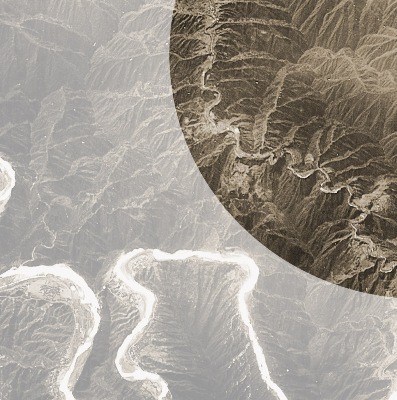
Great Wall of China from space,taken by Proba on march 25
One of the famous myth about the Great Wall is that it is visible to the unaided eye from the moon, whose average distance from Earth is 384,393km.The wall is a maximum 9.1m   wide, and is about the same color as the soil surrounding it.The apparent width of the Great Wall from the moon is the same as that of a human hair viewed from 3.2km away.To see the wall from the moon would require spatial resolution 17,000 times better than normal vision.So, no lunar astronaut has ever claimed to have seen the Great Wall from the moon.And NASA claims that it is barely visible from low earth orbit, and only under nearly perfect conditions; it is no more conspicuous than many other man-made objects.

The Great Wall also has long been incorporated into Chinese mythology and symbolism. The most well-known legend is about the collapse of a section of the wall caused by Meng Jiangan who cried bitterly over the death of her husband after he died while building the wall.

The Great Wall of China was listed as a World Heritage by UNESCO in 1987.Some of its sections are now in ruins or have disappeared, however, it is still one of the greatest wonders of the world and most appealing attractions all around the world owing to its architectural grandeur and historical significance.