
The Taj Mahal-Crown of Palaces,was built by Mughal emperor Shah Jahan in memory of his third wife,Mumtaz Mahal.It is a white mausoleum located in Agra,India.the Taj Mahal is widely recognized as "the jewel of Muslim Art in India and one of the universally admired masterpieces of the World's heritage". Taj Mahal -the epitome of love,is a monument of immeasurable beauty.It spread over 42 acres,on the banks of river Yamuna.It is believed that the name ' Taj Mahal 'is derived from the name of Mumtaz Mahal.The name Shah Jahan comes from Persian meaning "King of the World".
Taj Mahal was the fifth Mughal ruler after Babur,Humayun,Akbar and Jahangir.While young,he was a favorite of Akbar.Like Akbar,he was eager to expand his empire.In 1627,after the death of Jahangir,he succeeded to the Mughal throne.He is considered to be one of the greatest Mughals and his reign has been called the Golden Age of Mughals.
Shah Jahan erected many splendid monuments,the most famous of which is the Taj Mahal of Agra.He demonstrated a precocious talent for building,impressing his father at the age of 16,when he built his own quarters within Babur's fort and redesigned several buildings within Agra fort.The Pearl Mosque at Agra, the palace and great mosque at Delhi and the celebrated Peacock throne, said to be worth millions of dollars by modern estimates. He was the founder of Shahjahanabad, now known as 'Old Delhi'. Other creations of Shah Jahan also include the Diwan-i-Am and Diwan-i-Khas within the Red Fort in Delhi.

Arjumand Banu Begum was the daughter of Abdul Hasan Asaf Khan, a Persian noble.He was the brother of Empress Nur Jehan(wife of Jahangir).Betrothed to Prince Khurrum(Shah Jahan),in 1607 AD at the age of 14 years,she was married five years later on 10 May 1612.After their wedding celebrations, Khurrum "finding her in appearance and character elect among all the women of the time",gave her the title 'Mumtaz Mahal' Begum.The intervening years had seen Khurrum take two other wives.Mumtaz Mahal was Shah Jahan's trusted companion,travelling with him all over the Mughal Empire.His trust in her was so great that he even gave her his imperial seal, the Mu-hr Uzah. She was portrayed as the perfect wife with no aspirations to political power.Despite her frequent pregnancies, Mumtaz traveled with Shah Jahan's entourage throughout his earlier military campaigns.In the year 1631 AD,She died while accompanying her husband in Burhanpur(Madhya Pradesh) in a campaign to crush a rebellion, after giving birth to their 13th child, a daughter named Gauhara Begum.Her body was temporarily buried at Burhanpur in a walled pleasure garden known as Zainabad. Burhanpur was never intended by her husband as his wife's final resting spot.So her body was disinterred in December 1631 and transported in a golden casket back to Agra.
The death of Mumtaz so crushed the Emperor that all his hair and beard were said to have grown snow white in a few months.When Mumtaz was alive,she extracted 4 promises from the Emperor,
The death of Mumtaz so crushed the Emperor that all his hair and beard were said to have grown snow white in a few months.When Mumtaz was alive,she extracted 4 promises from the Emperor,
- that he build the Taj
- that he should marry again
- that he be kind to their children
- that he visit the tomb on her death anniversary.
The devoted Jahanara Begum, eldest daughter of Shah Jahan,gradually brought him out of grief and took the place of Mumtaz at court.The Queen Mumtaz Mahal's personal fortune valued at 10,000,000 rupees was divided by Shah Jahan between Jahanara Begum,who received half and rest of her surviving children.
The Taj Mahal ,an integrated complex of structures,started construction about 1631 AD.The principal mausoleum was completed in 1648 AD by employing thousands of artisans and craftsmen, whereas, the outlying buildings and gardens were finished five years later in1653 AD.Taj Mahal is the finest example of Mughal architecture, a style that combines elements from Persian, Turkish and Indian architectural styles.The construction of Taj Mahal was entrusted to a board of architects under imperial supervision, including Abdul Karim Ma'mur Khan, Makramat Khan and Us-tad Ahmad Lahauri. Lahauri is generally considered to be the principal designer.While earlier Mughal buildings were primarily constructed of red sand stone, Shah Jahan promoted the use of white marble inlaid with semi-precious stones and buildings under his patronage reached new levels of refinement.
The tomb is the central focus of the entire complex of the Taj Mahal.This large, white marble structure stands on a square plinth and consists of a symmetrical building with an arch-shaped doorway topped by a large dome and finial.Four minarets frame the tomb, one at each corner of the plinth facing the chamfered corners.The main chamber houses the false sarcophagi(a funeral receptacle for a corpse, most commonly carved or cut from stone) of Mumtaz Mahal and Shah Jahan; the actual graves are at a lower level.
The marble dome that surmounts the tomb is the most spectacular feature.Its height of around 35m is about same as the length of the base, and is accentuated as it sits on a cylindrical drum which is roughly 7m high.because of its shape, the dome is often called an onion dome.The top is decorated with a lotus design. The shape of the dome is emphasized by four smaller domed chattris placed at its corners, which replicate the onion shape of the main dome.The lotus motif is repeated on both the chattris and guldastas.The dome and chattris are topped by a gilded finial, which mixes traditional Persian and Hindustani decorative elements.The main finial was originally made of gold but was replaced by a copy made of gilded bronze in the early 19th century. The finial is topped by a moon,a typical Islamic motif whose horns point heavenward. because of its placement on the main spire, the horns of the moon and the finial point combine to create a trident shape, reminiscent to traditional Hindu symbols of Shiva.The minarets, which are each more than 40m tall, display the designer's penchant for symmetry.They were constructed slightly outside of the plinth so that, in the event of collapse, the material from the towers would tend to fall away from the tomb.
The exterior decorations of the Taj Mahal are among the finest in Mughal architecture.As the surface area changes, the decorations are refined proportionally.The decorative elements were created by applying paint, stucco, stone inlays or carvings.Throughout the complex, passages from the Qur'an are used as decorative elements.Recent scholarship suggests that thee passages were chosen by Amanat Khan.The calligraphy on the Great Gate reads "O Soul, thou art at rest. return to the Lord at peace with Him, and He at peace with you", created by a calligrapher named Abd ul-Haq, in 1609.
Muslim tradition forbids elaborate decoration of graves. Hence, the bodies of Mumtaz and Shah Jahan were put in a relatively plain crypt beneath the inner chamber with their faces turned right and towards Mecca.Mumtaz Mahal's cenotaph is placed at the precise center of the inner chamber on a rectangular marble base of 1.5 m by 2.5m. Both the base and casket are elaborately inlaid with precious and semiprecious gems. Calligraphic inscriptions on the casket identify and praise Mumtaz.The pen box and writing tablet were traditional Mughal funerary icons decorating the caskets of men and women respectively. The 99 Names of God are found as calligraphic inscriptions on the sides of the actual tomb of Mumtaz Mahal, in the crypt including "O Noble, O Magnificent, O Majestic, O Unique, O Eternal, O Glorious......".The tomb of Shah Jahan bears a calligraphic inscription that reads,"He traveled from this world to the banquet-hall of Eternity on the night of the twenty-sixth of the month of Ra-jab, in the year 1076 Hijri".
 The complex is set around a large 300m square charbagh or Mughal garden. A raised marble water tank at the center of the garden, halfway between the tomb and gateway with a reflecting pool on a north-south axis,reflects the image of the mausoleum. The raised marble water tank is called al Hawd al-Kawthar, in reference to the "Tank of Abundance" promised to Muhammad. Elsewhere the garden is laid out with avenues of trees and fountains.Most Mughal charbaghs are rectangular with a tomb in the center, but The Taj is unusual in that the main element, the tomb, is located at the end of the garden.
The Taj Mahal was constructed using materials from all over India and Asia and over 1000 elephants were used to transport building materials. The translucent white marble was brought from Makrana, Rajasthan, the jasper from Punjab, jade and crystal from China. The turquoise was from Tibet and the Lapis lazuli from Afghanistan, the Sapphire from Sri Lanka and the Carnelian from Arabia. In all, 28 types of precious and semi-precious stones were inlaid into the white marble.A labour force of 20,000 workers was recruited across northern India. Sculptors from Bukhara, calligraphers from Persia, in-layers from southern India, stonecutters from Baluchistan, a specialist in building turrets, another who carved only marble flowers were part of the 37 men who formed the creative unit.
Soon after the Taj Mahal's completion, Shah Jahan was deposed by his son Aurangzeb and put under house arrest at nearby Agra Fort.Upon Shah Jahan's death,Aurangzeb buried him in the mausoleum next to his wife.By the late 19th century, parts of the buildings had fallen badly into disrepair.During the time of the Indian rebellion of 1857, the Taj Mahal was defaced by British soldiers and government officials, who chiseled out precious stones and Lapis lazuli from its wall.At the end of the 19th century, the garden was remodeled with British style lawns that are still in place today.
The Taj Mahal attracts between 2 million and 4 million visitors annually.In 1983, the Taj Mahal became a UNESCO World Heritage Site.Polluting traffic is not allowed near the complex and tourists must either walk from parking lots or catch an electric bus.
No wonder if millions of people chose it to be amongst the World's top wonders.
The tomb is the central focus of the entire complex of the Taj Mahal.This large, white marble structure stands on a square plinth and consists of a symmetrical building with an arch-shaped doorway topped by a large dome and finial.Four minarets frame the tomb, one at each corner of the plinth facing the chamfered corners.The main chamber houses the false sarcophagi(a funeral receptacle for a corpse, most commonly carved or cut from stone) of Mumtaz Mahal and Shah Jahan; the actual graves are at a lower level.
The marble dome that surmounts the tomb is the most spectacular feature.Its height of around 35m is about same as the length of the base, and is accentuated as it sits on a cylindrical drum which is roughly 7m high.because of its shape, the dome is often called an onion dome.The top is decorated with a lotus design. The shape of the dome is emphasized by four smaller domed chattris placed at its corners, which replicate the onion shape of the main dome.The lotus motif is repeated on both the chattris and guldastas.The dome and chattris are topped by a gilded finial, which mixes traditional Persian and Hindustani decorative elements.The main finial was originally made of gold but was replaced by a copy made of gilded bronze in the early 19th century. The finial is topped by a moon,a typical Islamic motif whose horns point heavenward. because of its placement on the main spire, the horns of the moon and the finial point combine to create a trident shape, reminiscent to traditional Hindu symbols of Shiva.The minarets, which are each more than 40m tall, display the designer's penchant for symmetry.They were constructed slightly outside of the plinth so that, in the event of collapse, the material from the towers would tend to fall away from the tomb.
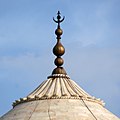 |
| Finial |
 |
| plant motifs |
The exterior decorations of the Taj Mahal are among the finest in Mughal architecture.As the surface area changes, the decorations are refined proportionally.The decorative elements were created by applying paint, stucco, stone inlays or carvings.Throughout the complex, passages from the Qur'an are used as decorative elements.Recent scholarship suggests that thee passages were chosen by Amanat Khan.The calligraphy on the Great Gate reads "O Soul, thou art at rest. return to the Lord at peace with Him, and He at peace with you", created by a calligrapher named Abd ul-Haq, in 1609.
 |
| Tombs of Shah Jahan & Mumtaz Mahal |
| interior |
Muslim tradition forbids elaborate decoration of graves. Hence, the bodies of Mumtaz and Shah Jahan were put in a relatively plain crypt beneath the inner chamber with their faces turned right and towards Mecca.Mumtaz Mahal's cenotaph is placed at the precise center of the inner chamber on a rectangular marble base of 1.5 m by 2.5m. Both the base and casket are elaborately inlaid with precious and semiprecious gems. Calligraphic inscriptions on the casket identify and praise Mumtaz.The pen box and writing tablet were traditional Mughal funerary icons decorating the caskets of men and women respectively. The 99 Names of God are found as calligraphic inscriptions on the sides of the actual tomb of Mumtaz Mahal, in the crypt including "O Noble, O Magnificent, O Majestic, O Unique, O Eternal, O Glorious......".The tomb of Shah Jahan bears a calligraphic inscription that reads,"He traveled from this world to the banquet-hall of Eternity on the night of the twenty-sixth of the month of Ra-jab, in the year 1076 Hijri".
The Taj Mahal was constructed using materials from all over India and Asia and over 1000 elephants were used to transport building materials. The translucent white marble was brought from Makrana, Rajasthan, the jasper from Punjab, jade and crystal from China. The turquoise was from Tibet and the Lapis lazuli from Afghanistan, the Sapphire from Sri Lanka and the Carnelian from Arabia. In all, 28 types of precious and semi-precious stones were inlaid into the white marble.A labour force of 20,000 workers was recruited across northern India. Sculptors from Bukhara, calligraphers from Persia, in-layers from southern India, stonecutters from Baluchistan, a specialist in building turrets, another who carved only marble flowers were part of the 37 men who formed the creative unit.
Soon after the Taj Mahal's completion, Shah Jahan was deposed by his son Aurangzeb and put under house arrest at nearby Agra Fort.Upon Shah Jahan's death,Aurangzeb buried him in the mausoleum next to his wife.By the late 19th century, parts of the buildings had fallen badly into disrepair.During the time of the Indian rebellion of 1857, the Taj Mahal was defaced by British soldiers and government officials, who chiseled out precious stones and Lapis lazuli from its wall.At the end of the 19th century, the garden was remodeled with British style lawns that are still in place today.
The Taj Mahal attracts between 2 million and 4 million visitors annually.In 1983, the Taj Mahal became a UNESCO World Heritage Site.Polluting traffic is not allowed near the complex and tourists must either walk from parking lots or catch an electric bus.
No wonder if millions of people chose it to be amongst the World's top wonders.


No comments:
Post a Comment