Monday, January 30, 2012

THE COLOSSEUM


Titus
The greatest amphitheatre of the antiquity-The Colosseum-was built in Rome, Italy, about 1931 years ago.It is considered as an architectural and engineering wonder and remains as a standing proof of both the grandeur and the cruelty of the Roman world.The Roman Colosseum was originally known as the Flavian Amphitheatre which was commissioned in 72 AD by Emperor VESPASIAN. It was completed by his son, TITUS, in 80 AD, with later improvements by DOMITIAN. It was built by the Flavian emperors as a gift to the Roman citizens, in the place where the previous Emperor Nero had build his residence,the Domus Aurea. Located on marshy land between the Esquiline and Caelian Hills, it was the first permanent amphitheatre to be built in Rome. The monumental structure has fallen into ruins, but even today it is an imposing and beautiful sight.


The elliptical building is immense, measuring 188m by 156m and reaching a height of more than 48m(roughly equivalent to a 12-15 storey building).It could accommodate about 50,000 spectators who could enter the building through no less than 80 entrances.Above the ground are four storeys, the upper storey contained seating for lower classes and women. The lowest storey was preserved for prominent citizens.Below the ground were rooms with mechanical devices and cages containing wild animals. The cages could be hoisted, enabling the animals to appear in the middle of the arena. Eighty walls radiate from the arena and support vaults for passageways, stairways and the tiers of seats. At the outer edge circumferential arcades link each level and the stairways between levels.

The Colosseum was covered with an enormous awning known as the velarium, which protected the spectators from the sun. It was attached to large poles on top of the Colosseum and anchored to the ground by large ropes. The awning was installed by a team of about 1,000 men.The construction of Colosseum utilized a careful combination of types: concrete for the foundations, travertine for the piers and arcades, tufa infill between piers for the walls of the lower two levels, and brick-faced concrete used for the upper levels and for most of the vaults.The arena was covered with a great wooden floor and canvas to make it waterproof.Over this was a layer of sand to absorb blood.The arena was surrounded by a 5m high wall to protect spectators from attacks by wild beasts.

The interior of the Colosseum

Emperors used the Colosseum to entertain the public with free games. Those games were a symbol of prestige and power and they were a way for an emperor to increase his popularity. Hundred-day games were held by Titus to mark the inauguration of the building in AD 80. During the time, about 9,000 wild animals were slaughtered. Games were held for a whole day or even several days in a row. They usually started with comical acts and displays of exotic animals and ended with fights to the death between animals and gladiators or between gladiators. These fighters were usually slaves, prisoners of war or condemned criminals. Sometimes free Romans and even Emperors took part in the action.The statistics of those who met their death at the Colosseum during another festival, held in 240 AD, are staggering: 2,000 gladiators, 70 lions, 40 wild horses, 30 elephants, 30 leopards, 20 wild asses, 19 giraffes, 10 elks, 10 hyenas, 10 tigers, 1 hippopotamus and 1 rhinoceros.Gladiatorial combats were outlawed by the Christian Emperor Honorius in 407 AD because of a simple monk named Telemachus, who is the only Colosseum martyr of whom there is any evidence.The long-held belief that scores of Christians met their death here in the 1st to 3rd centuries has no evidence to support it and may only be a legend. The fights with wild beasts were banned in 523 AD. After this, the arena went out of use.In this period, the Colosseum was used as a Christian burial ground. Early Christian tombs have been found in three areas around the amphitheatre.


The southern side of the Colosseum was felled by an earthquake in 847 AD. Parts of the building-including the marble facade-were used for the construction of later monuments, including the St. Peter's Basilica.Looting of the stone continued on and off until the 18th century, when Pope Benedict XIV declared the Colosseum sanctified by the blood of early Christian martyrs and added Stations of the Cross to the arena.After this it was restored and excavated, a work that continues to the present day.It is one of Rome's most popular tourist attractions and each Good Friday, the Pope leads a torch-lit "Way of the Cross" procession that starts in the area around the Colosseum.The amphitheatre becomes a symbol of the international campaign against capital punishment, abolished in Italy in 1948.It was voted as one of the New Seven Wonders of the World.


Wednesday, January 25, 2012

TAJ MAHAL


The Taj Mahal-Crown of Palaces,was built by Mughal emperor Shah Jahan in memory of his third wife,Mumtaz Mahal.It is a white mausoleum located in Agra,India.the  Taj Mahal  is widely recognized as "the jewel of Muslim Art in India and one of the universally admired masterpieces of the World's heritage". Taj Mahal -the epitome of love,is a monument of immeasurable beauty.It spread over 42 acres,on the banks of river Yamuna.It is believed that the name ' Taj Mahal 'is derived from the name of Mumtaz Mahal.The name Shah Jahan comes from Persian meaning "King of the World".

 Taj Mahal was the fifth Mughal ruler after Babur,Humayun,Akbar and Jahangir.While young,he was a favorite of Akbar.Like Akbar,he was eager to expand his empire.In 1627,after the death of Jahangir,he succeeded to the Mughal throne.He is considered to be one of the greatest Mughals and his reign has been called the Golden Age of Mughals.

Shah Jahan erected many splendid monuments,the most  famous of which is the  Taj Mahal of Agra.He demonstrated a precocious talent for building,impressing his father at the age of 16,when he built his own quarters within Babur's fort and redesigned several buildings within Agra fort.The Pearl Mosque at Agra, the palace and great mosque at Delhi and the celebrated Peacock throne, said to be worth millions of dollars by modern estimates. He was the founder of Shahjahanabad, now known as 'Old Delhi'. Other creations of Shah Jahan also include the Diwan-i-Am and Diwan-i-Khas within the Red Fort in Delhi.


Arjumand Banu Begum was the daughter of Abdul Hasan Asaf Khan, a Persian noble.He was the brother of Empress Nur Jehan(wife of Jahangir).Betrothed to Prince Khurrum(Shah Jahan),in 1607 AD at the age of 14 years,she was married five years later on 10 May 1612.After their wedding celebrations, Khurrum "finding her in appearance and character elect among all the women of the time",gave her the title 'Mumtaz Mahal' Begum.The intervening years had seen Khurrum take two other wives.Mumtaz Mahal was Shah Jahan's trusted companion,travelling with him all over the Mughal Empire.His trust in her was so great that he even gave her his imperial seal, the Mu-hr Uzah. She was portrayed as the perfect wife with no aspirations to political power.Despite her frequent pregnancies, Mumtaz traveled with Shah Jahan's entourage throughout his earlier military campaigns.In the year 1631 AD,She died while accompanying her husband in Burhanpur(Madhya Pradesh) in a campaign to crush a rebellion, after giving birth to their 13th child, a daughter named Gauhara Begum.Her body was temporarily buried at Burhanpur in a walled pleasure garden known as Zainabad. Burhanpur was never intended by her husband as his wife's final resting spot.So her body was disinterred in December 1631 and transported in a golden casket back to Agra.

The death  of Mumtaz so crushed the Emperor that all his hair and beard were said to have grown snow white in a few months.When Mumtaz was alive,she extracted 4 promises from the Emperor,
  • that he build the Taj
  • that he should marry again
  • that he be kind to their children
  • that he visit the tomb on her death anniversary.
So immediately after the burial in Burhanpur, he began planning the design and construction of a suitable mausoleum and funerary garden in Agra for his wife.However due to ill health and being under house arrest by his own son and successor to the throne,Aurangzeb, barred him from continue to keep the last promise.
The devoted Jahanara Begum, eldest daughter of Shah Jahan,gradually brought him out of grief and took the place of Mumtaz at court.The Queen Mumtaz Mahal's personal fortune valued at 10,000,000 rupees was divided by Shah Jahan between Jahanara Begum,who received half and rest of her surviving children.

The Taj Mahal ,an integrated complex of structures,started construction about 1631 AD.The principal mausoleum was completed in 1648 AD by employing thousands of artisans and craftsmen, whereas, the outlying buildings and gardens were finished five years later in1653 AD.Taj Mahal is the finest example of Mughal architecture, a style that combines elements from Persian, Turkish and Indian architectural styles.The construction of Taj Mahal was entrusted to a board of architects under imperial supervision, including Abdul Karim Ma'mur Khan, Makramat Khan and Us-tad Ahmad Lahauri. Lahauri is generally considered to be the principal designer.While earlier Mughal buildings were primarily constructed of red sand stone, Shah Jahan promoted the use of white marble inlaid with semi-precious stones and buildings under his patronage reached new levels of refinement.

The tomb is the central focus of the entire complex of the Taj Mahal.This large, white marble structure stands on a square plinth and consists of a symmetrical building with an arch-shaped doorway topped by a large dome and finial.Four minarets frame the tomb, one at each corner of the plinth facing the chamfered corners.The main chamber houses the false sarcophagi(a funeral receptacle for a corpse, most commonly carved or cut from stone) of Mumtaz Mahal and Shah Jahan; the actual graves are at a  lower level.

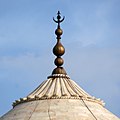
The marble dome that surmounts the tomb is the most spectacular feature.Its height of around 35m is about same as the length of the base, and is accentuated as it sits on a cylindrical drum which is roughly 7m high.because of its shape, the dome is often called an onion dome.The top is decorated with a lotus design. The shape of the dome is emphasized by four smaller domed chattris placed at its corners, which replicate the onion shape of the main dome.The lotus motif is repeated on both the chattris and guldastas.The dome and chattris are topped by a gilded finial, which mixes traditional Persian and Hindustani decorative elements.The main finial was originally made of gold but was replaced by a copy made of gilded bronze in the early 19th century. The finial is topped by a moon,a typical Islamic motif whose horns point heavenward. because of its placement on the main spire, the horns of the moon and the finial point combine to create a trident shape, reminiscent to traditional Hindu symbols of Shiva.The minarets, which are each more than 40m tall, display the designer's penchant for symmetry.They were constructed slightly outside of the plinth so that, in the event of collapse, the material from the towers would tend to fall away from the tomb.

Finial
plant motifs


The exterior decorations of the Taj Mahal are among the finest in Mughal architecture.As the surface area changes, the decorations are refined proportionally.The decorative elements were created by applying paint, stucco, stone inlays or carvings.Throughout the complex, passages from the Qur'an are used as decorative elements.Recent scholarship suggests that thee passages were chosen by Amanat Khan.The calligraphy on the Great Gate reads "O Soul, thou art at rest. return to the Lord at peace with Him, and He at peace with you", created by a calligrapher named Abd ul-Haq, in 1609.

Tombs of Shah Jahan & Mumtaz Mahal
interior


Muslim tradition forbids elaborate decoration of graves. Hence, the bodies of Mumtaz and Shah Jahan were put in a relatively plain crypt beneath the inner chamber with their faces turned right and towards Mecca.Mumtaz Mahal's cenotaph is placed at the precise center of the inner chamber on a rectangular marble base of 1.5 m by 2.5m. Both the base and casket are elaborately inlaid with precious and semiprecious gems. Calligraphic inscriptions on the casket identify and praise Mumtaz.The pen box and writing tablet were traditional Mughal funerary icons decorating the caskets of men and women respectively. The 99 Names of God are found as calligraphic inscriptions on the sides of the actual tomb of Mumtaz Mahal, in the crypt including "O Noble, O Magnificent, O Majestic, O Unique, O Eternal, O Glorious......".The tomb of Shah Jahan bears a calligraphic inscription that reads,"He traveled from this world to the banquet-hall of Eternity on the night of the twenty-sixth of the month of Ra-jab, in the year 1076 Hijri".


The complex is set around a large 300m square charbagh or Mughal garden. A raised marble water tank at the center of the garden, halfway between the tomb and gateway with a reflecting pool on a north-south axis,reflects the image of the mausoleum. The raised marble water tank is called al Hawd al-Kawthar, in reference to the "Tank of Abundance" promised to Muhammad. Elsewhere the garden is laid out with avenues of trees and fountains.Most Mughal charbaghs are rectangular with a tomb in the center, but The Taj is unusual in that the main element, the tomb, is located at the end of the garden.

The Taj Mahal was constructed using materials from all over India and Asia and over 1000 elephants were used to transport building materials. The translucent white marble was brought from Makrana, Rajasthan, the jasper from Punjab, jade and crystal from China. The turquoise was from Tibet and the Lapis lazuli from Afghanistan, the Sapphire from Sri Lanka and the Carnelian from Arabia. In all, 28 types of precious and semi-precious stones were inlaid into the white marble.A labour force of 20,000 workers was recruited across northern India. Sculptors from Bukhara, calligraphers from Persia, in-layers from southern India, stonecutters from Baluchistan, a specialist in building turrets, another who carved only marble flowers were part of the 37 men who formed the creative unit.

Soon after the Taj Mahal's completion, Shah Jahan was deposed by his son Aurangzeb and put under house arrest at nearby Agra Fort.Upon Shah Jahan's death,Aurangzeb buried him in the mausoleum next to his wife.By the late 19th century, parts of the buildings had fallen badly into disrepair.During the time of the Indian rebellion of 1857, the Taj Mahal was defaced by British soldiers and government officials, who chiseled out precious stones and Lapis lazuli from its wall.At the end of the 19th century, the garden was remodeled with British style lawns that are still in place today.

The Taj Mahal attracts between 2 million and 4 million visitors annually.In 1983, the Taj Mahal became a UNESCO World Heritage Site.Polluting traffic is not allowed near the complex and tourists must either walk from parking lots or catch an electric bus.

No wonder if millions of people chose it to be amongst the World's top wonders.


Wednesday, January 18, 2012

PETRA


The Jordanian ancient city PETRA, meaning 'rock', is a historical and archaeological city in the Jordanian govern-orate, which is famous for its rock-cut architecture and water conduits system. It is a symbol of Jordan as well as its most visited tourist attraction. It lies on the slope of Mount Hor in a basin among the mountains which form the eastern flank of Arab-ah, the large valley running from the Dead Sea to the Gulf of Aquaba. The  site remained unknown to the western world until 1812, when it was introduced by Swiss explorer Johann Ludwig Burckhardt. It was described as "a rose-red city half as old as time" in a Newdigate Prize winning poem by John William Burgon.


During 1200 BC, the Petra area was populated by Edomites and the area was known as Edom (red). Before the Israelite incursions, the Edomites controlled the trade routes from Arabia in the south to Damascus in the north. Edomites at Petra were known for their wisdom, their writing, textile industry, the excellence and fineness of their ceramics, and their skilled metal working.


The next chapter of history belongs to the Persian period, during which, the Nabataeans (ancient people of Arabia) migrated into Edom, forcing the Edomites to move into Southern Palestine. At this time, during the Hellenistic rule of the Seleucid s, and later, the Ptolemies, the whole area flourished with increased trade and the establishment of new towns such as Philadelphia (now Amman) and Gerasa (now Jerash).Infighting between the Seleucid s and Ptolemies allowed the Nabataeans to gain control over the caravan (camel train) routes between Arabia and Syria.


With Nabataean rule, Petra become the center for spice trade. It was during this period, that the most impressive structures of Petra were built, including the Treasury, the Great Temple and the Qasr El-Bint El-Faroun.Their classical monuments reflect the international character of the Nabataean economy through their combination of native tradition and the classical spirit. But among the most remarkable of all Nabataean achievements is the hydraulic engineering system they developed including water conservation systems and the dams that were constructed to divert the rush of swollen winter waters that create flash floods.


In 63-64 BC, the Nabataeans were conquered by the Romans. Completely subsumed by the Romans under the emperor Trajan in 106 CE (AD) , Petra and Nabataea then become part of the Roman province known as Arabia Petraea with its capital at Petra. By 313CE, Christianity had become a state-recognized religion. In 330CE, the Emperor Constantine established  the Eastern Roman Empire with its capital at Constantinople. Although 363 earthquake destroyed half of the city, it appears that Petra retained its urban vitality into late antiquity. The inhabitants during the Byzantine period recycled many standing structures and rock-cut monuments, while also constructing their own buildings, including churches. Among the rock-cut monuments, they reused the Great Tomb or The Monastery (a cross carved in the wall gave the structure its popular name), which was modified into a church.


Islam arrived in the Arab invasion of the 7th century. Aaron's tomb, on a mountain near Petra, is an important Muslim shrine (holy also to Jews and Christians) and dates from the 14th century. In the 12th century, A Crusader outpost was built in Petra, then it became a "lost city", known only to local Arabs.Petra was rediscovered by Burckhardt in 1812.More than 100 years later, Thomas Edward Lawrence (Lawrence of Arabia)wrote in his book, "The Seven Pillars of Wisdom", 'Petra is the most beautiful city in the world'. Archaeological excavations in Petra took place only since the 20s of the 20th century. A little later, the tourist development began in ruins.


In 1985 Petra was designated a UNESCO World Heritage Site.UNESCO has described it as "one of the most precious cultural properties of man's cultural heritage". Petra was chosen by the BBC as one of the 40 places you have to see before you die. On July 7, 2007, Petra was named one of the New Seven Wonders of the World.


Bab as-Siq


The journey to Petra's center begins in the Bab as-Siq, a modern gravel road with a side for horses and aside for pedestrians. It runs alongside the Wadi Musa, which is dry most of the year but runs with water in the winter.


The Siq


The Siq (the shaft), is a mile long narrow gorge that leads into the city of Petra, emerging dramatically in front of the Treasury along the way.  It was not formed by erosion but tectonic forces, which caused the rock to split dramatically in half. It was only then the waters of the Wadi Musa flowed in and the winds blew through the newly formed gap, gradually rounding the sharp edges into smooth curves.

Monday, January 16, 2012

CHICHEN ITZA


Chichen Itza, world famous archaeological zone, is located 120 km from Merida via federal highway 180, in the state of Yucatan, Mexico. The name Chichen Itza is derived from the Mayan language which means "at the mouth of the Itza well". The city was the center of political, economic,religious, and military power during the period 600 and 1250 A.D, not only in Yucatan but also in the entire southeastern part of Mesoamerica.


Chichen Itza rule brought about drastic changes in the internal structure of Yucatan communities. At the same time, the introduction of an Innovative view of the world marked the establishment of an order characterized by changing commercial values, production and distribution systems, and residential and religious architecture of the groups int he power.


Chichen Itza was founded in the year 514 A.D by the priest Lakin Chan who was also called Itzamma. That is why their people were called Chanes or Itza-es.When the Spaniards arrived to Chichen Itza, it had been abandoned as a consequence of the civil war fought with Mayapan.In between 1196 & 1441 the final collapse of this culture took place in the north of the peninsula.


The Mayan Toltec style are:
  • El Juego De la Pelota
  • El Castillo
  • El Grupo De las Mil Columnas
  • El tzompantli
  • El Edificio De las Aguilas
  • El templo De los Guerrerros
  • El Mercado

All of these buildings have the same decoration motives found in Tula. The most frequent representations are warriors and Quetzalcoatl. The cult of the Feathered Serpent, Quetzalcoatl in Tula and Kukulkan in Mayan was very important.The largest Ball Game in Mesoamerica is found in Chichen Itza.

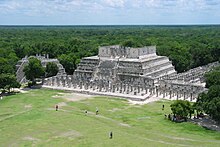
The Kukulkan pyramid known as "El Castillo" is the place where the ceremony of the descent of Kukulkan was held. The pyramid has special astronomical layout so that a game of light and shadow is formed. On March 21st, the body of the serpent metaphorically descends from the temple on top of the pyramid and arrives at the heads at the foot of the staircase. Excavations in the interior show that there is a smaller Castillo in the interior.

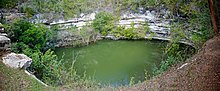
Chichen Itza is the most visited archaeological site in the peninsula of Yucatan,due to its extraordinary architecture beauty and its geographical location. In 2007, it is selected as one of the new seven world wonders which is exactly 24m high considering the upper platform. Chichen Itza is one of the largest Maya cities, with the relatively densely clustered architecture of the site core covering an area of at least 5 square km. The Yucatan Peninsula is a limestone plain, with no rivers or streams. The region is pockmarked with natural sink holes, called cenotes, which expose the water table to the surface. One of the most impressive of these is the Cenote Sagrado, which is 60m in diameter, and sheer cliffs that drop to the water table some 27m below. The Cenote Sagrado was a place of pilgrimage for ancient Maya people who would conduct sacrifices during times of drought.Archaeological investigations support this as thousands of objects such as gold, jade, shell, wood, cloth and even skeletons of children and men have been removed from the bottom of the cenote.


Mayans and their prediction-The End of the World

Mayans are from an ancient  civilization who settled in the Mesoamerica around 250 A.D.They lived an agricultural life therefore very much connected with nature. They were influenced by the cultures of the cities they captured and reflected it to their art  and architecture.

The biggest mystery of Mayan Civilization is the Maya Calender, that has been reminded by the movie "2012", according to which the end is approaching soon.They created a calender called Long Count, about 3500 years ago based on their great skill of mathematics and astrology. And this ancient calender worries modern scholars because of the date it ends.


The calender is not an astronomic calender. Just like the Mayan Pyramids, the calender also consists of 9 layers which represents nine eras. Each layer shortens 1/20 of the previous layer. Layers have 6 nights and 7 days, totally 13parts which affects the humanity with different energies they symbolize. Shortly, Mayan Calender shows the evolution of human conscious, this is what makes this calender special.


According to Mayan Calender, each day has its own significance. Each day has a symbol and a number and the characteristics of the day that you are born shape your destiny. Going back to some historical events, you may see that they overlap with the Mayan Calender. The first layer of Mayan Calender goes back to 16billion years when the galaxies were formed. The second era starts 820 million years ago when the course of existence has started. The third layer starts with the mammals appearing which lasts for 40 million years. At the fourth layer, mankind appears within 2 million years. Fifth layer consists of 100 thousand years when the mankind starts to socialize and create. At the sixth layer the civilization starts around 3100BC, about 5000years ago. The seventh layer dates back to 1755 when mankind improves with the industrial revolution and starts to colonize. The next layer starts in 1999, where an alternate conscious overtakes the previous one which is equality.


According to the pyramid of Mayan Calender, changes happen so quickly at each layer. This calender is reliable for some researchers because the Mayans predicted the year  when their civilization would be invaded by the foreigners, they predicted the world wars and every solar and lunar eclipse until today. With 8th November 2009, we are going into a  new night change according to Mayan Calender. This is going to be a bigger crisis. However they never predicted anything about 2012. but may be they did but we don't know as the Spanish when they attacked there, burnt the books of the Mayans and unfortunately today we only have a few of their sources.


Does the mystery end here-21st December 2012?
What is going to happen?
Let us wait and see...........

Saturday, January 14, 2012

MACHU PICCHU

The mysterious lost Inca City of Machu Picchu was discovered a 100 years ago, by American explorer Hiram Bingham.It was discovered on July 25, 1911 and was officially recognized as one of the new world wonder in 2007. the ruins in the Urubamba valley,510 km south of Lima,have 250,000 visitors a year.

The word 'Machu Picchu' means "old mountain" in Quechua, the ancient language of the Incas. It is located in the Cusca Region of Peru, on the top of a mountain, 2430m above sea level. Most archeologists believe that Machu Picchu was built as an estate for the Inca emperor Pachacutec (1438-1472). Although known locally, it was unknown to the outside world until 1911.Since then, the region has become an important tourist attraction.By 1976, 30% of Machu Picchu had been restored. Machu Picchu was declared a Peruvian Historical Sanctuary in 1981 and a UNESCO  World Heritage Site in 1983.


Hiram Bingham, who discovered the site, was worked as a lecturer at Yale University and had been searching  for the city of Vilcabamba, the last Inca refuge during the Spanish conquest. He had worked for years around the zone. Pablito Alvarez, a local 11 year-old Quechua boy, led Bingham up to Machu Picchu. Bingham called the complex "The Lost City  of Incas", which was the title of his first book.

UNESCO is describing Machu Picchu as "an absolute masterpiece of architecture and a unique testimony to the Inca civilization". Machu Picchu was both a center of worship and astronomic observatory as well as the private retreat of the family of Inca ruler Pachacutec. It is split into two major areas: the agricultural zone, made up of terracing and food storehouses; and the urban zone, featuring the sacred sector, with temples, squares and royal tombs which have been carved to an extra ordinary degree of perfection.


The Machu Picchu Historic Sanctuary, and particularly the forests that line both banks of the Urubamba river, below the citadel of Machu Picchu itself, are home to the habitats of an enormous variety of bird species.The Sanctuary also protects unique species of flora and fauna, the cock-of-the-rocks (Peru's national bird), the spectacled bear, rare dwarf deer called Sachacarba, the Huemal deer, bright colored orchids and tree-born ferns, considered treasures of the Sanctuary.


Wednesday, January 11, 2012

CHRIST-THE REDEEMER


    The statue of Christ-the redeemer is the most representative symbol of Rio de Janeiro and Brazil. It was recently elected as one of the seven new world wonders.It is considered as the second largest Art Deco statue in the world. The statue is 39.6m tall, including its 9.5m pedestal, and 30m wide.
         It is located at the peak of the 700m Corcovado Mountain in the Tijuca Forest National Park overlooking the city. It weighs 635 tons, and is made of reinforced concrete and soapstone, and was constructed between 1922 & 1931.It was designed by a local engineer, Heitor da Silva Costs and was sculpted by French sculptor Paul Landowski.The total cost was equivalent of $250,000($3,068,097 in2011).The monument was officially opened on October 12, 1931.


Rio de Janeiro


Rio de Janeiro is the second largest city of Brazil and South America. It is the third largest metropolitan area in South America.
It is nicknamed as “Marvelous City”.
It is famous for its natural beauty, Carnival celebrations, Samba music, tourist beaches and Maracana Stadium.
Other important landmarks are Sugarloaf Mountain with its cable car, largest urban forests in the world (Tijuca Forest & White Stone State Park), and botanical garden (with more than 7000 species of trees and plants-brazil wood, giant imperial palm tree…).